
GRE scores don’t correlate with graduate school success

My car inundated with GRE supplies

“When I get students in the lab…I will warn them that the skills that made them academically bright are not going to be the skills that will help them as scientists”
-Dr. Daniel Colón-Ramos; Yale Professor of Neuroscience and Cell Biology

Each year, graduate admissions committees rely on Graduate Record Examinations (GRE) scores as an “objective” mark to screen out applications. Growing skeptical of the predictive power the test promises, several universities recently launched studies investigating if several measures of PhD success correlate with GRE scores.

PART ONE: GRE scores don’t correlate significantly with grad school success.
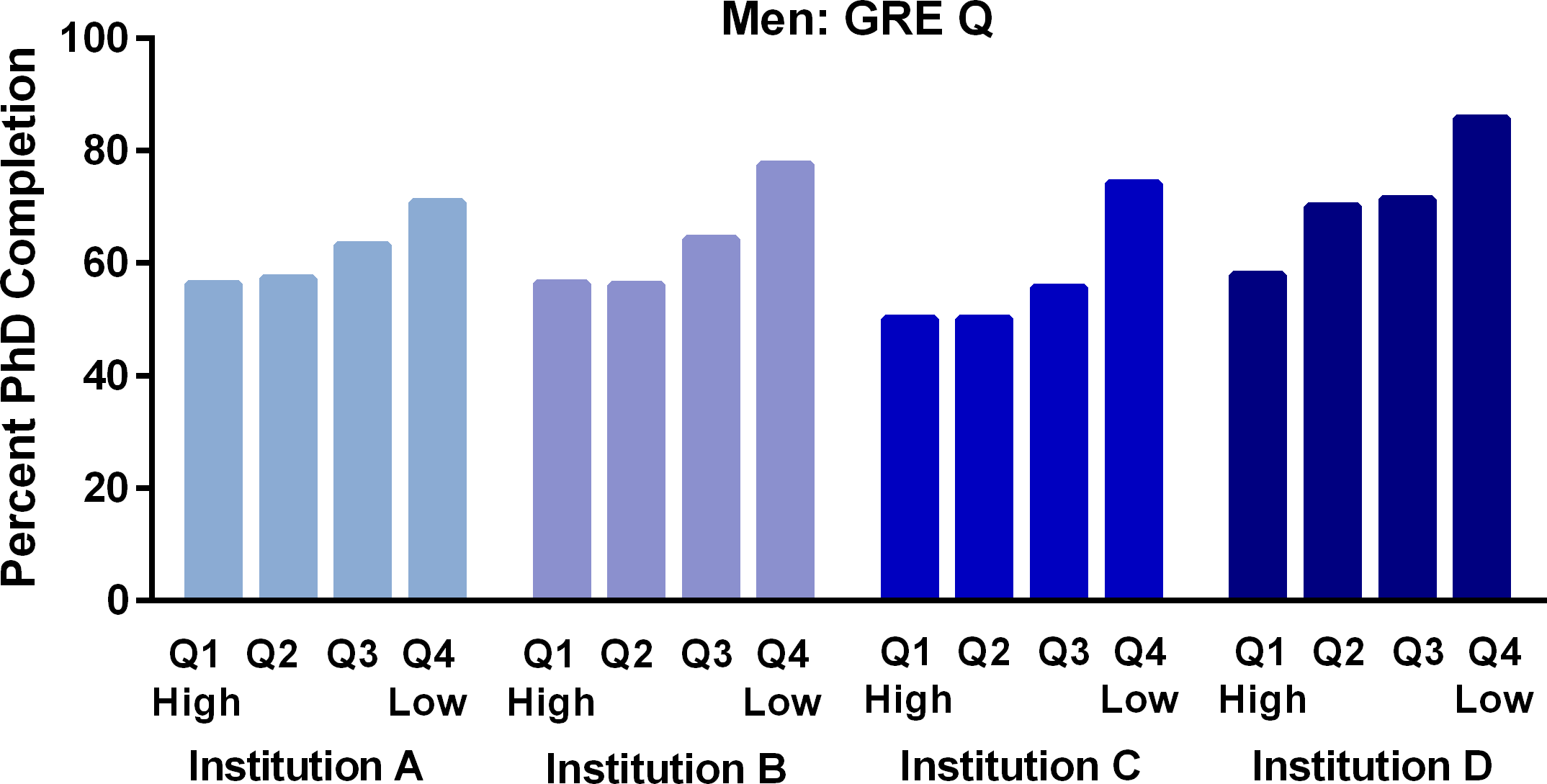
Figure 1. A Multi-institutional analysis of STEM graduate student PhD completion as a function of GRE Quantitatative scores.

One study authored by Petersen et al. (1) gathered data of the degree completion rates in STEM programs from four flagship research universities. The team used a logistic regression to model degree completion as a function of “institution, gender and GRE V or GRE Q scores”. The results showed that men who scored in the lowest GRE Q percentile also had significantly higher rates of PhD completion (Figure 1). Women’s performance on the GRE Q section showed no significant correlation with degree completion in STEM programs. GRE scores also did not predict degree completion time.

Another study authored by Moneta-Koehler et. al (2) gathered data from 683 students enrolled in their Interdisciplinary Graduate Program (IGP) from 2003 until 2011. The team compared their performance on the GRE Quantitative, Verbal, and Analytical Writing sections with various measures of graduate school success. The measures assessed included ” (1) graduation with a Ph.D., (2) passing the qualifying exam, (3) time to defense, (4) number of presentations at national or international meetings at time of defense, (5) number of first author peer-reviewed publications at time of defense, (6) obtaining an individual grant or fellowship, (7) performance in the first semester coursework, (8) cumulative graduate GPA, and (9) final assessment of the competence of the student as a scientist as evaluated by the research mentor “. The results showed no correlation between GRE Q scores with time to defense, number of presentations, or first author publications (Figure 2). Another study authored by Joshua Hall et al. (3) at University of North Carolina Chapel Hill also found no correlation between the number of first author publications and GRE scores of 280 students in their biomedical PhD program (Figure 3).
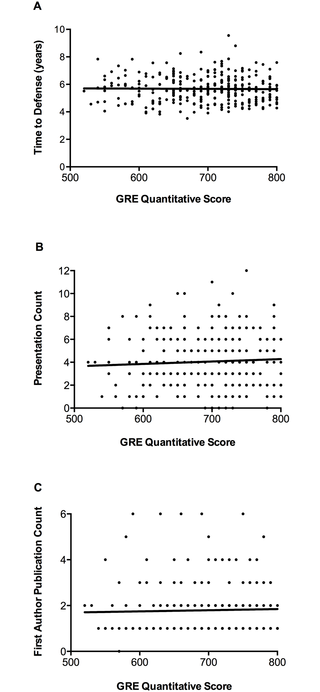

Figure 2. Results from a study conducted by Vanderbilt University correlating GRE Q scores with various metrics of graduate school success.
Figure 3. Results from a study conducted by a research team at University of North Carolina Chapel Hill found no correlation between GRE scores and first author papers

It seems as though performance on the GRE fails to predict or even correlate with the success of the admitted graduate students in their STEM programs. Does performance on these tests correlate with anything? Yes.

PART TWO: Okay, so, what DO GRE scores predict?

Your skin color and gender. Nature study authored by physicists Casey Miller and Keivan Stassun (3) found troubling disparities in test performance across demographics. STEM graduate admissions programs often place a lot of stock in the quantitative portion of the GRE when deciding whether or not an applicant should be admitted. Data from the Educational Test Service (ETS), the developers of the GRE, show that women score “80 points lower on average in the physical sciences than do men, and African Americans score 200 points below white people” (Figure 4).
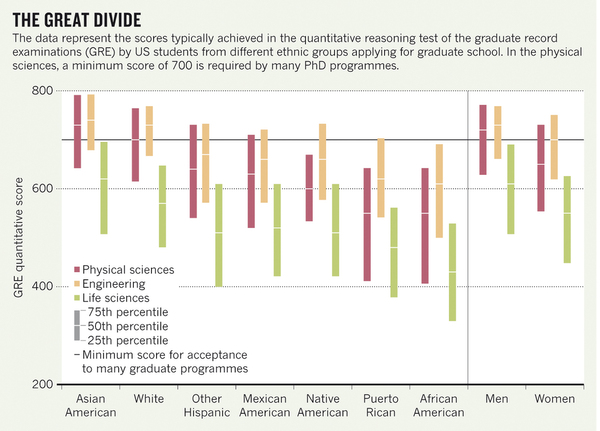
Figure 4. Data sourced from the ETS showing the respective GRE Q performances of various ethnic groups.

In the physical sciences, only 26% of women score above a 700 on the GRE, wheras 73% of men make this measure. If the admissions committees do not account for gender and ethnicity, then using GRE scores as a metric to screen out “under-qualified” applicants bottlenecks the diversity of their graduate student body.

PART THREE: The Great GRExit

In light of these troubling revelations, universities and agencies which fund them are dropping the GRE as an application requirement. To name a few programs, the University of Michigan’s biomedical sciences program dropped the test in 2017, with the program director stating “[asking]
students to invest money and effort in a test whose usefulness our faculty cannot agree on [would be] a questionable policy,” . The University of San Francisco dropped the requirement for these programs, and 7/8 schools of Emory University’s GDBBS program are also dropping the test. The National Institute of Health (NIH) changed its GRE policies for attaining individual fellowships and training grants in 2015, and the National Science Foundation (NSF) dropped the test in 2010 (4). A comprehensive list of STEM programs no longer requiring the GRE may be found here.

References:
1) Petersen SL, Erenrich ES, Levine DL, Vigoreaux J, Gile K (2018) Multi-institutional study of GRE scores as predictors of STEM PhD degree completion: GRE gets a low mark. PLoS ONE 13(10): e0206570. https://doi.org/10.1371/journal.pone.0206570

2) Moneta-Koehler L, Brown AM, Petrie KA, Evans BJ, Chalkley R (2017) The Limitations of the GRE in Predicting Success in Biomedical Graduate School. PLoS ONE 12(1): e0166742. https://doi.org/10.1371/journal.pone.0166742

3) Casey Miller & Keivan Stassun (2014) A Test that Fails. Nature 510, 303-304. https://www.nature.com/naturejobs/science/articles/10.1038/nj7504-303a

4)https://www.sciencemag.org/careers/2017/08/updated-biomedical-phd-program-major-research-university-drops-gre-requirement

Featured

10 Questions to Ask Yourself Before Selecting a Graduate Program


Congratulations! It’s mid-December and you’ve just pressed “submit” on your graduate applications. The hardest part is over, and now it’s time for you to sit back and … well, now what? Believe it or not, some graduate schools may be calling you in early January to set-up interviews with you. So for one, start taking those “hmmm maybe that’s spam?” calls. Earning admittance into graduate school is a huge step in your career, one notoriously difficult and even painful at times. Attending a graduate program that suits your priorities will guide you through the bewildering world of higher education. How do you choose the program that may be best fit for you? Ask yourself these 10 questions (in order of decreasing importance).

  1. How many faculty members at this institution would I want to work with?

Your future PI will exert considerable influence on your scientific career. From training you in the cutting-edge techniques of your field, to publishing your work, assisting you with funding, graduating you on time (or not), writing letters of recommendation, and allowing you access to a prolific professional network, your relationship with your PI will last longer than your PhD. Your candidate programs should have 4-6 people with whom you could see yourself working alongside. Things to consider include the following:

  • How many publications have they published within the last two years?
  • Did they publish grad students?
  • How many graduate students have they successfully trained and graduated?
  • How many years did it take former students to graduate, typically? Past performance indicates future performance.
  • Do they have funding?

I made an excel spreadsheet of each faculty member and the aforementioned data. I can’t recommend using scopus enough to help you get a feel for the publications and citation record associated with each author (you can login via your undergraduate institution)

2. How many faculty members at this institution have room for a new student?

While you’re interviewing, or before attending the interview, ask your prospective PI’s about funding. Be straightforward, it’s okay.

3. Are last years students happy? Is there a “buddy” system?

Typically, first year students will guide you around the campus during interviews. Don’t be afraid to add them on social media and get a feel for how they’re liking the program. Having a tight-nit cohort gives you a support group of awesome, motivated people. At my institution, each incoming student is assigned a neurobuddy, and my neurobuddy was a god-send! He offered to help me move, tipped me off to a university-exclusive housing guide, and checked in with me and others in my cohort frequently to ensure we were adjusting well. Doctoral programs are tough. Moving out can be tough. Look to last year’s students to see how tight-nit and well-adjusted they are.

4. Am I responsible for my own funding?

This is a personal question and the importance varies from applicant to applicant. Different programs will offer different stipends, benefits, and tuition breaks. As a newly christened PhD student of Chemistry told me in my undergraduate days “If you’re paying for graduate school, you’re doing it wrong”. Where funding opportunities lack, ask if your prospective adviser will help you find funding. Check to see what the local cost of living is to compare apples to apples.

5. Where are the alumni of this program working now?

Sometimes the program’s web-page will feature a link with a list of alumni and what they are doing now. Check out most recent alumni, the mid-career alumni, and the more seasoned alumni. In general, would you be happy being a post-doc at one of those places or working for a start up at another one of those places? If most of those alumni are in industry jobs, and your heart is set on academia, this may be a red flag.

6. What opportunities exist for career development?

Employment prospects for PhD’s outside of academia are expanding. Industry sector jobs, government sector jobs, science-writing/editing, and technology transfer are only a few examples of burgeoning careers outside of academia. Programs educating their students in the career possibilities outside of academia AND offering training opportunities for them offer a sharp edge in career development.

If you’re interested, the NSF recently published an interactive database noting career trends (employment, pay, etc..) for doctorates in STEM fields. You can sort by institution and by specific program.

7.What opportunities exist for outreach?

Scientists live in symbiosis with the community. Tax-dollars fund the creation of knowledge through scientific experiments and the fruits of our labor benefit humanity. This relationship depends upon clear communication with the public about our work.

Outreach opportunities allow scientists to engage directly with the community; kindling enthusiasm, sparking questions, and clarifying misconceptions where they arise. Everyone is a natural-born scientist. The scientific enterprise flourishes with a diverse labor force. Although we may take these truths for granted, visiting classrooms and hosting STEM booths at the city fair reminds people that science is for, and works for, everyone. Scientific outreach not only educates the public about your work, it inspires them to support it.

Informing the electorate about your research will grant them the understanding and motivation to support your work and appoint representatives to support it as well (Thanks, Obama). Getting involved is as much apart of being a scientist as is publishing, peer-reviewing, or pipetting.

Wherever you may end up, please be a good science-citizen and be apart of the community which helps to enrich the education, engagement, endowment of STEM fields.

8. How rich are networking opportunities within the community?

Find out what networks exist in the community. This will be important as you enter the workforce. For example, Atlanta is home to the Center for Disease Control (CDC), GeorgiaTech, and GeorgiaBio. Emory University, my institution, offers internships with the CDC and GeorgiaTech, to those who are eligible.

9. Ask your gut.

Sometimes things just rub you the wrong way, and that’s okay. Sometimes the program just feels right. Take note of these feelings.

10. Is the community casual or formal?

This is a personal preference thing, although I enjoy a more casual atmosphere.

So, you return home from your successful interviews and you really like a few programs. What to do next? Don’t be afraid to email some of the current graduate students for questions about their experience. They will be the most candid with you. Send your interviewees a personalized thank-you email and let them know that this program is a priority for you. Despite receiving offers from a few other universities, Emory University was my top-pick, and I couldn’t be happier with this program. I personally think that sending a few emails to the faculty and students underscoring my interest in the program helped me receive a letter of acceptance from them.

Good luck everyone, the worst part is over! A graduate program is an enriching experience which will teach you how to think critically and create new knowledge. It is as enthralling as it is frustrating. In these next few months, you will be getting calls and emails inviting you to visit campus’s. The programs of interest will try their hardest to recruit each of the attendees, and will showcase the assets they have to offer you. Now it’s time for you to be selective.